Version Changes
Version changes are the backbone of Cadwyn. They allow to describe things like "this field in that schema had a different name in an older version" or "this endpoint did not exist in all earlier versions".
In Cadwyn, your business logic always works with a single version: HEAD, from which Cadwyn generates every other version. This approach decouples your business logic from versioning and allows you to support hundreds of API versions using the same database models and business logic, while staying sane.
Follow these steps to add a new version:
- Introduce a breaking change in your HEAD version
- Apply reverse changes to older versions using special "migration instructions" so that your current users are not affected by the breaking changes
Migration instructions for reverting breaking changes should be grouped to simplify maintenance efforts. For example, renaming the creation_date field to created_at and deleting the GET /v1/tax_ids endpoint are unrelated changes and should be placed in separate groups. In contrast, deleting the POST /v1/tax_ids endpoint should be grouped with deleting the GET /v1/tax_ids. Such grouping makes the changes easier to understand for both your users and developers.
Each such group is called a version change:
# versions/v2023_02_10.py

from cadwyn import VersionChange, endpoint


class RemoveTaxIdEndpoints(VersionChange):
    """The 'GET /v1/tax_ids' and 'POST /v1/tax_ids' endpoints have been
    removed because tax IDs are now managed on customer records.
    """

    instructions_to_migrate_to_previous_version = (
        endpoint("/v1/tax_ids", ["GET", "POST"]).existed,
    )
After describing the groups, add your version change class(es) to your version bundle to activate them:
# versions/__init__.py

from cadwyn import HeadVersion, Version, VersionBundle

from .v2023_02_10 import RemoveTaxIdEndpoints

versions = VersionBundle(
    HeadVersion(),
    Version("2023-02-10", RemoveTaxIdEndpoints),
    Version("2022-11-16"),
)
This instructs Cadwyn to undelete these endpoints in all versions before 2023-02-10.
The following explains what each part does and why:
VersionBundle
VersionBundle is the single source of truth for your list of versions. It stores all versions and all version changes associated with them. Each version change represents a group of breaking changes. Each Version contains a group of version changes that led to its creation. For example, if you delete the POST /v1/tax_ids endpoint in version 2023-02-10, you need to add a corresponding version change to the 2023-02-10 version. For example:
# versions/__init__.py

from cadwyn import HeadVersion, Version, VersionBundle

from .v2023_02_10 import RemoveTaxIdEndpoints

versions = VersionBundle(
    HeadVersion(),
    Version("2023-02-10", RemoveTaxIdEndpoints),
    Version("2022-11-16"),
)
Did you notice that the initial 2022-11-16 version has no version changes? That is intentional. How could it have breaking changes if there were no prior versions?
Version
Version is an ordered collection of version changes that describes when each version change occurred allowing Cadwyn to generate schemas and routes for all versions correctly, based on which version changes belong to which versions.
HeadVersion
Cadwyn has a special HEAD version: it is the only version you will create manually and use directly in your business logic. Cadwyn generates all other versions from HEAD version. When handling an HTTP request, Cadwyn first validates it against the requested API version. Then all the data migrations from the requested API version up to the latest API version are applied to it. Finally, Cadwyn converts the request to the requested schema from HEAD version (the schema that was used to generate the versioned schema from the requested API version).
So Cadwyn migrates all requests from all versions to HEAD version to ensure that your business logic operates on a single version.
HEAD is very similar to your latest version but for a few key differences:
- Latest is user-facing while HEAD is only used internally by you and Cadwyn
- Latest is generated while HEAD is maintained by you manually
- Latest includes only the fields that API user is supposed to see while HEAD may include some fields missing from latest. For example, if an earlier version contained a field completely incompatible with latest, HEAD will still include it to ensure that older versions continue to function as before. This also applies to field types: if a field is required in latest but was nullable in an earlier version, then HEAD will keep it nullable to ensure that earlier version requests can easily be converted into HEAD requests
- Latest may include constraints that are incompatible with older versions while HEAD may contain none. If you prefer, the user-facing schemas are applied for validation before the request is converted to HEAD so HEAD does not need to re-validate anything if you do not want it to
VersionChange
VersionChange classes describe each atomic group of business capabilities that you have altered in a version.
Note, however, that a migration is required only if it is a breaking change for your users. If you add a new endpoint or a new field to your response schema, you do not need a migration because it will not break your users’ code. If you do not create a migration, this change is automatically added to all versions.
VersionChange.__name__
The name of a version change should clearly describe the breaking change it introduces. For example, RemoveTaxIdEndpoints immediately communicates what has changed. The name should begin with a verb and serve as the primary clue for developers unfamiliar with the history of the project to understand the difference between versions. Do not hesitate to use long, descriptive names. It is better to choose a verbose name that precisely conveys the change than a short, generic one. For example RenameCreationDatetimeAndUpdateDatetimeToCreatedAtAndUpdatedAt is far more informative than RefactorFields. After only a few poorly named version changes, the entire versioning history can become difficult to read and understand:
versions = VersionBundle(
    Version("2023-05-09", ChangeCreateLogic, AddRequiredFields),
    Version("2023-04-02", DeleteEndpoint, ChangeFields, RenameFields),
    Version("2023-02-10", RenameEndpoints, RefactorFields),
    Version("2022-11-16"),
)
VersionChange.description
Write the description of your version change as its class docstring. Cadwyn uses this docstring as the description of the version change.
The description should clearly communicate to your clients what happened and why. Make it grammatically correct, detailed, specific, and written for humans. Note that you do not have to use a strict machine-readable format: it is a piece of documentation, not a set of instructions. As a reference, consider the following version change description from Stripe:
Event objects (and webhooks) will now render a `request` subobject that contains a request Id and idempotency key instead of a string request Id.
It is concise, descriptive, and human-readable — qualities of effective technical documentation. Now compare it with a less helpful description:
Migration from the first version (2022-11-16) to 2023-09-01 version.
Changes:
* Changed schema for `POST /v1/tax_ids` endpoint
- Its first line,
Migration from the first version (2022-11-16) to 2023-09-01 version., duplicates the already-known information. Your developers can determine which versionVersionChangemigrates to and from by its location in VersionBundle and most likely by its file name. So it is redundant information - Its second line,
Changes:, does not provide useful information either because a description of aVersionChangecannot describe anything but changes. So again, it is redundant information - Its third line,
Changed schema for 'POST /v1/tax_ids' endpoint, provides both too much and too little information. It states that a schema was changed but it does not specify what was changed. The goal is to make it easy for your clients to migrate from one version to the next. A more useful description would mention the OpenAPI model name that was changed, the fields that were modified, and the reason for those changes
VersionChange.instructions_to_migrate_to_previous_version
In Cadwyn, you use the HEAD version. This attribute allows you to describe how your schemas and endpoints looked in previous versions. Cadwyn uses this information to determine how to generate the schemas and routes to recreate the previous schemas and endpoints for your clients. So you only need to maintain your HEAD schemas and your migrations while Cadwyn handles the rest. In fact, you put minimal effort into maintaining your migrations because they are effectively immutable records of the breaking changes that happened in the past. Once written, they do not need to be modified.
This approach of maintaining the present and describing the past may seem counterintuitive at first. The key is to adopt the correct mindset. After one or two attempts at versioning you will see how much sense this approach makes.
Suppose you need to know what your code looked like two weeks ago. You would use git checkout or git reset to jump to an older commit because Git stores the latest version of your code (referred to as HEAD) and the diffs between it and each previous version as a chain of changes. Cadwyn works the same way: Cadwyn stores only the HEAD version and regenerates previous versions on demand using diffs.
Note for curious readers
Git doesn't actually work this way internally. The description above is closer to how SVN works. It is just a simple metaphor to explain a concept.Data migrations
Consider a scenario where you rename the creation_date field to created_at. You have updated your schemas — that's great! However, clients using previous versions of the API will continue to send requests containing creation_date instead of created_at. How do you handle this? Well, in Cadwyn your business logic never receives requests from the previous versions. Instead, it receives only the requests of the HEAD version. So whenever you define a version change that renames a field, you also need to specify how to convert the request body from the previous version to the new one. For example:
from cadwyn import (
    RequestInfo,
    VersionChange,
    convert_request_to_next_version_for,
    schema,
)
from invoices import InvoiceCreateRequest


class RenameInvoiceCreationDateToCreatedAt(VersionChange):
    """Invoice creation timestamps are now returned as 'created_at' instead of
    'creation_date' to align with the API's other timestamp fields.
    """

    instructions_to_migrate_to_previous_version = (
        schema(InvoiceCreateRequest)
        .field("created_at")
        .had(name="creation_date"),
    )

    @convert_request_to_next_version_for(InvoiceCreateRequest)
    def rename_creation_date_to_created_at(request: RequestInfo):
        request.body["created_at"] = request.body.pop("creation_date")
Did you notice how the schema for InvoiceCreateRequest is specified in the migration above? This instructs Cadwyn to apply it to all routes that use this schema as their request body.
At this point, you have described not only how the schemas have changed, but also how to migrate a request from the previous version to the new one. When Cadwyn receives a request targeting a specific API version, it first validates the request against the schema for that version. Then Cadwyn applies each request migration in sequence up to the latest version. As a result, your business logic always receives the HEAD version of the request, while from your clients’ perspective, multiple API versions are available. Cadwyn allows you to support versioned APIs without adding complexity to your business logic.
If the body is a list or a dict of schemas, such as list[InvoiceCreateRequest], or a tuple or a set of them, request.body holds the instances of the schemas of the client's version instead of dicts. A migration can change their attributes or replace them with dicts. After the migrations, Cadwyn passes the fields that are set and the extra keys of the instances in lists and dicts to the HEAD version, so it gets what the client has sent, as long as Cadwyn can be sure that it's right (see the known limitations).
Computed fields are left out of model request bodies, including nested models: migrations that need their values must compute them, and endpoints should not expect them in model_extra. Models that override model_dump() keep their previous dumping behavior (see known limitations).
Cadwyn follows FastAPI's strict_content_type setting when reading bodies. Send Content-Type: application/json for JSON; without it, migrations may receive raw bytes rather than a dict. To accept JSON without that header, set strict_content_type=False on the app, router, or route.
If Cadwyn restores validation aliases before validating the HEAD request, it solves the HEAD dependencies once and reports that restored body's errors in CadwynHeadRequestValidationError. A field with a default supplied only by a custom core schema no longer falls back to that default for a rejected value: remove the value in a request migration if that fallback is intended.
A request migration can also remove a body that is not a form: if it sets request.body = None, the HEAD version gets the request without a body, so the defaults of its body params apply. If no migration assigns request.body, an omitted body stays omitted, and on FastAPI 0.151.0 and newer, a JSON null body stays null.
But wait... What happens to the Invoice responses? Your business logic now returns created_at, which means clients using previous API versions will be affected. Cadwyn solves this as well by allowing you to define response migrations. Requests are migrated forward in versions while responses are migrated backward in versions. In other words, your business logic returns a response of the HEAD version and Cadwyn will use your response migrations to migrate the response back to the version of your client's request:
from cadwyn import (
    RequestInfo,
    ResponseInfo,
    VersionChange,
    convert_request_to_next_version_for,
    convert_response_to_previous_version_for,
    schema,
)
from invoices import (
    BaseInvoice,
    InvoiceCreateRequest,
    InvoiceResource,
)


class RenameInvoiceCreationDateToCreatedAt(VersionChange):
    """Invoice creation timestamps are now returned as 'created_at' instead of
    'creation_date' to align with the API's other timestamp fields.
    """

    instructions_to_migrate_to_previous_version = (
        schema(BaseInvoice).field("created_at").had(name="creation_date"),
    )

    @convert_request_to_next_version_for(InvoiceCreateRequest)
    def rename_creation_date_to_created_at(request: RequestInfo):
        request.body["created_at"] = request.body.pop("creation_date")

    @convert_response_to_previous_version_for(InvoiceResource)
    def rename_created_at_to_creation_date(response: ResponseInfo):
        response.body["creation_date"] = response.body.pop("created_at")
Did you notice how the schema for InvoiceResource is specified in the migration above? This instructs Cadwyn to apply it to all routes with this schema as their response_model. Also notice that BaseInvoice is now used in the instructions. Here, BaseInvoice is the parent of both InvoiceCreateRequest and InvoiceResource, so renaming it in the instructions will rename the field in those schemas as well. Rename an inherited field in the parent like this. Renaming it only in a child schema fails at startup, because the child would still inherit the old field from its parent. If a child schema changed the field in a newer version or declares it again, rename it in that child and in the parent in the same version. Otherwise, Cadwyn fails at startup too, because the child would keep the old field next to the renamed one.
Migrations only run for the schema you name
Instructions such as schema(InvoiceResource).field(...).had(...) change the schema everywhere it is used, including inside other schemas and generics. Request and response migrations are different: a migration by schema only runs when its schema is the request body or the response_model of the route itself. It does not run for that schema nested in another one, e.g. in a field of another schema or inside a generic such as Page[InvoiceResource], so write the migration for the outer schema instead. This is a deliberate choice: each migration runs exactly where you declared it and never twice for the same data.
Unions of schemas
If the request body or the response_model is a union that has the schema as a member, e.g. Union[InvoiceResource, RefundResource] or Optional[InvoiceResource], the migration runs only for the requests and responses that are that member. For requests, that's the member that the body of the client's version validates into. For responses, it's the member whose model the endpoint returns an object of, so an object of a subclass of the schema, such as an internal representation, counts as the schema, and None is no member. A migration declared for the union itself (convert_response_to_previous_version_for(Union[InvoiceResource, RefundResource])) replaces the migrations of its members in the same version change. Annotated and named type aliases (TypeAliasType("Resource", Union[InvoiceResource, RefundResource])) mean the same as their value.
If Cadwyn can't tell which member a request or a response is, it fails with a CadwynError instead of guessing, but only if a migration of a member would run:
- The endpoint returns something else than an object of a member's model or
None, e.g. a dict or a database object. Cadwyn could only find out which member it becomes by validating it, which would run its validators twice, because FastAPI validates it again with the models of the client's version after the migrations. Return an object of the member's model, or migrate the endpoint by its path. - The endpoint returns a
Responseobject, such as aJSONResponse, which FastAPI doesn't validate. Return an object of the member's model instead (e.g.InvoiceResource(...), not the dict that you put in theJSONResponse), or migrate the endpoint by its path. - The response or the body is an object of several members that don't inherit from each other (e.g.
class Both(InvoiceResource, RefundResource)). Use an object of only one of them, or migrate the endpoint by its path. - The request body param has an alias (
Body(alias=...)), so the endpoint doesn't get the body under the name that Cadwyn looks it up by. Remove the alias, or migrate the endpoint by its path.
A migration of a member with migrate_http_errors=True fails at startup with a RouterGenerationError if a union route exists in a version that it migrates, because an error isn't any member of the union. Migrate the errors of the endpoint by its path instead.
When a request comes in, Cadwyn migrates it to the HEAD version using the request migration. You then handle your business logic, return the HEAD response, and Cadwyn migrates it back to the requested API version. Does your business logic or database know that you have two versions? No, not at all. It is zero-cost. Consider the benefits of supporting not just two, but two hundred versions.
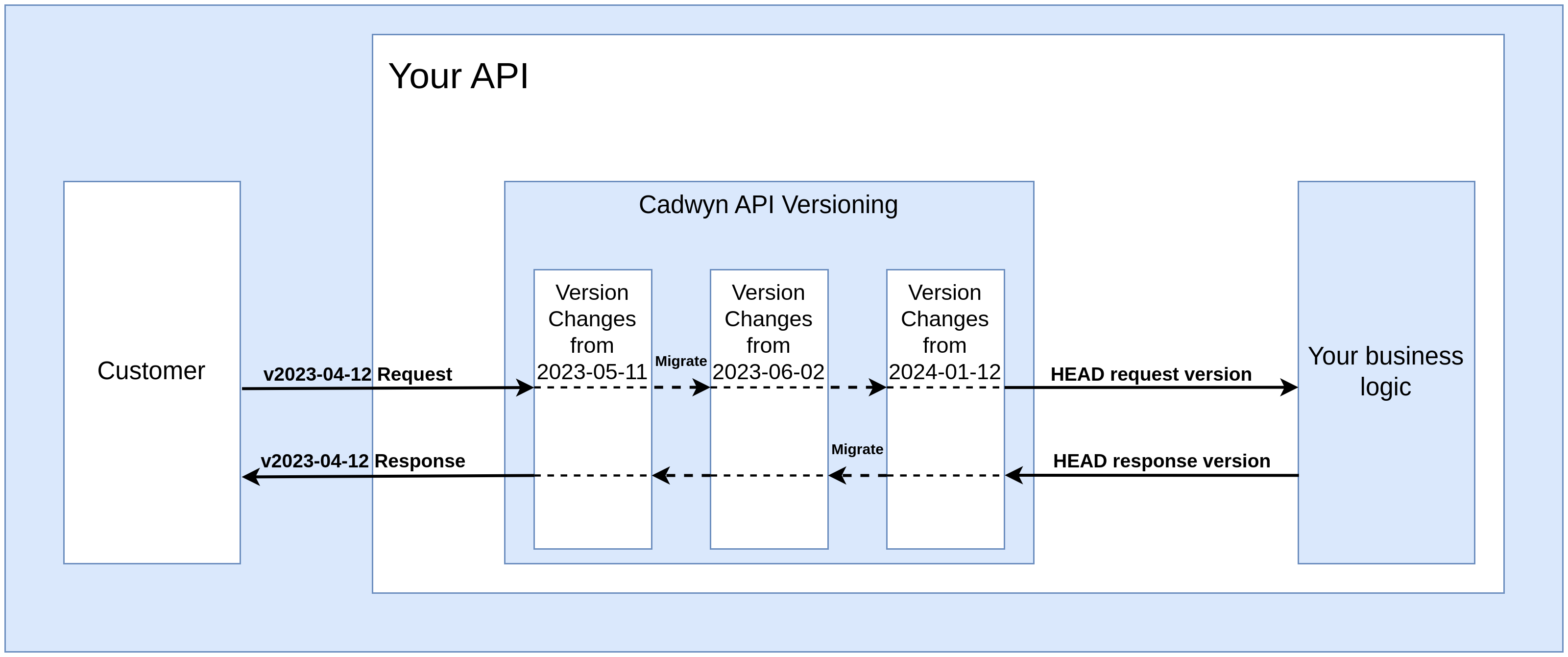
Did you notice how the HEAD versions of the schemas are used in the migration above? Such pattern can be found everywhere in Cadwyn. The HEAD version of your schemas is used to describe what happened to all other versions because other versions might not exist when you are defining migrations for them.
Migrations by path
Often you need to migrate based on the endpoint path rather than the request body or response model. This happens when, for example, an endpoint does not have a request body, or its response model is used in other places that you do not want to migrate. Consider the example above, but use paths instead of schemas:
from cadwyn import (
    RequestInfo,
    ResponseInfo,
    VersionChange,
    convert_request_to_next_version_for,
    convert_response_to_previous_version_for,
    schema,
)
from invoices import BaseInvoice


class RenameInvoiceCreationDateToCreatedAt(VersionChange):
    """Invoice creation timestamps are now returned as 'created_at' instead of
    'creation_date' to align with the API's other timestamp fields.
    """

    instructions_to_migrate_to_previous_version = (
        schema(BaseInvoice).field("created_at").had(name="creation_date"),
    )

    @convert_request_to_next_version_for("/v1/invoices", ["POST"])
    def rename_creation_date_to_created_at(request: RequestInfo):
        request.body["created_at"] = request.body.pop("creation_date")

    @convert_response_to_previous_version_for("/v1/invoices", ["GET"])
    def rename_created_at_to_creation_date(response: ResponseInfo):
        response.body["creation_date"] = response.body.pop("created_at")
That said, schemas are highly recommended, since it is much easier to introduce inconsistencies when using paths. For example, if you have ten endpoints sharing the same response body schema, you might forget to add migrations for three of them because you are using paths instead of schemas.
Migration of HTTP errors
Often you need to raise fastapi.HTTPException in your code to signal an error to your users. However, changing the status code of an error would be a breaking change because your error status codes - and sometimes even the response bodies - are part of your API contract.
By default, Cadwyn's response migrations do not handle errors, but you can enable error handling with the migrate_http_errors keyword argument:
from cadwyn import (
    ResponseInfo,
    VersionChange,
    convert_response_to_previous_version_for,
)


class ReplaceInvoiceNotFoundStatusCode400With404(VersionChange):
    """Missing invoices from 'GET /v1/invoices' now return 404 instead of 400
    so clients can distinguish absent resources from invalid requests.
    """

    instructions_to_migrate_to_previous_version = ()

    @convert_response_to_previous_version_for(
        "/v1/invoices", ["GET"], migrate_http_errors=True
    )
    def replace_404_with_400(response: ResponseInfo):
        if response.status_code == 404:
            response.status_code = 400
Migration of non-body attributes
Cadwyn can migrate more than just request bodies.
RequestInfo has the following interfaces to migrate requests:
body: Anyheaders: starlette.datastructures.MutableHeaderscookies: dict[str, str]query_params: dict[str, str]form: list[tuple[str, UploadFile | str]] | Nonefor requests to endpoints that declare their form fields as separateForm()orFile()parameters. Otherwise it isNone. For example, an endpoint that takes a single model throughForm()gets the model's fields as a dict inbodyinstead
If a migration reads an uploaded file from form, it must seek the file back to where the HEAD version should start reading it, usually upload.file.seek(0). Otherwise, the HEAD version gets the file as the migration left it, e.g. empty.
Uploads stay open for background tasks, including the uploads that migrations add and later replace or remove. Cadwyn closes all of them after the response and its background tasks, even if the client disconnects. See known limitations for closes that never finish.
ResponseInfo has the following interfaces to migrate responses:
body: Anystatus_code: intheaders: starlette.datastructures.MutableHeaders- set_cookie
- delete_cookie
Internal representations
So far, only simple cases have been considered. But what happens if you cannot migrate your data that easily? This can happen if your earlier versions stored more data than your newer versions. Or if they supported more data formats.
Suppose the User schema previously had a list of addresses, but now you want to make a breaking change and replace addresses with a single address. A naive migration would take the first address from the list in each request and convert that address into a list in each response as follows:
from cadwyn import (
    RequestInfo,
    ResponseInfo,
    VersionChange,
    convert_request_to_next_version_for,
    convert_response_to_previous_version_for,
    schema,
)
from users import BaseUser


# AN EXAMPLE OF A POOR MIGRATION
class ReplaceUserAddressesWithAddress(VersionChange):
    """Users now expose a single 'address' instead of 'addresses' because only
    one mailing address is supported.
    """

    instructions_to_migrate_to_previous_version = (
        schema(BaseUser).field("address").didnt_exist,
        schema(BaseUser).field("addresses").existed_as(type=list[str]),
    )

    @convert_request_to_next_version_for(BaseUser)
    def turn_addresses_into_a_single_item(request: RequestInfo):
        addresses = request.body.pop("addresses")
        # The list might have been empty previously so new 'address'
        # field must be nullable.
        request.body["address"] = addresses[0] if addresses else None

    @convert_response_to_previous_version_for(BaseUser)
    def turn_address_into_a_list(response: ResponseInfo):
        response.body["addresses"] = [response.body.pop("address")]
But this will not work. If the user of the previous version requests to save three addresses, only one will actually be saved. Existing data is also going to be affected: if old users had multiple addresses, only one of them will be returned. This is important: a breaking change has been introduced.
In order to solve this issue, Cadwyn uses a concept of internal representations. An internal representation of your data is like a database entry for your data — it consists of its latest version plus all the fields that are incompatible with the latest API version. If the discussion were about classes, then internal representation would be a child of your latest schemas - it has all the same data and a little more, expanding its functionality. Your internal representation of user object can contain much more data than your latest schemas.
So all your requests get migrated to HEAD, which is the internal representation of latest, rather than the latest itself. Its data is very similar to that of latest. The same applies to your responses: instead of responding with and migrating from the latest version of your data, you use its internal representation which is pretty similar to the actual latest schemas.
For responses, returning the internal representation is simple: return your database model or a dictionary with everything you need for all your versions. In the user address example, it is recommended to continue storing the list of addresses in the database and include a single address in a response. The latest schemas will strip it while previous schemas will be able to use it.
# in your business logic
@router.get("/users/{user_id}", response_model=User)
async def get_user(user_id: int):
    user = database[user_id]
    return {
        "address": user.addresses[0] if user.addresses else None,
        **user.model_dump(),
    }
So now your migration will look like the following:
from cadwyn import VersionChange, schema
from users import User


class ReplaceUserAddressesWithAddress(VersionChange):
    """Users now expose a single 'address' instead of 'addresses' because only
    one mailing address is supported.
    """

    instructions_to_migrate_to_previous_version = (
        schema(User).field("address").didnt_exist,
        schema(User).field("addresses").existed_as(type=list[str]),
    )
Yes, you no longer need any of the migrations because responses are handled automatically. See the how-to section for an example of how to achieve the same result with requests.
Migrations outside of routes
Sometimes you need to migrate data outside of routes, e.g. to send a webhook or a message from a worker in a client's version, to read a message that a client of an older version has put into a queue, or to version an API that isn't built with FastAPI. Use migrate_response() and migrate_request() for that. They run the same migrations by schema as routes, so the same version changes give the same data either way. Migrations by path don't run, since there is no route.
migrate_response() does what a route does with what your endpoint returns:
from cadwyn import migrate_response
from users import UserResource
from versions import versions

response_from_2000_01_01 = migrate_response(
    versions, UserResource, body=UserResource(name="John"), version="2000-01-01"
)
It turns the models in body into data with all of their fields, as routes with the default response_model_exclude_* settings do (dump them yourself to exclude some), passes it through the migrations by schema of UserResource from HEAD down to 2000-01-01, and validates the result with the 2000-01-01 version of UserResource. It returns a MigratedResponse with that body, the status_code, which is 200 unless you pass another one, and the headers, which include the cookies that the migrations set. If a migration turns the response into an error (a status code of 300 or more), body is the error body as the migrations have left it, because it's not a UserResource anymore, and the older migrations that don't set migrate_http_errors=True don't run, as in routes. A route returns a 500 in that case instead, because FastAPI validates the error body as the response model. body takes objects of the HEAD models, or, with from_version, of that version's models: objects of other versions' models in the body raise a CadwynError instead of getting too many or too few migrations, also inside dicts, lists, tuples, sets, and other model objects. The bodies of errors can have any models.
Like route responses, migrate_response() restores validation aliases only when missing keys would certainly fail validation, such as required fields or forbidden extras. In other cases, make migrations set validation keys explicitly, e.g. v for Field(alias="x", validation_alias="v"). Restored bodies are validated once and report their own errors; aliased fields whose defaults come only from custom core schemas keep supplied values or reject invalid ones instead of silently using defaults. To request the default, delete the value in a response migration, or from body before calling migrate_response().
migrate_request() does what a route does with a request before it calls your endpoint:
from cadwyn import migrate_request
from users import UserCreateRequest
from versions import versions

request_from_2000_01_01 = migrate_request(
    versions,
    UserCreateRequest,
    body={"full_name": "John"},
    version="2000-01-01",
    headers={"x-request-id": "42"},
)
It validates the body with the 2000-01-01 version of UserCreateRequest, passes the data that the client has set through the migrations by schema of UserCreateRequest up to HEAD, and returns a MigratedRequest with the HEAD UserCreateRequest that your business logic expects as its body, and the migrated headers, cookies, and query_params. Pass it the data that the client has sent, as a route gets it, or objects of that version's models: objects of other versions' models in the body, e.g. HEAD objects, raise a CadwynError, also inside dicts, lists, tuples, sets, and other model objects, because the migrations would migrate their data again. If the body doesn't fit its version, you get Pydantic's ValidationError. If the migrated body doesn't fit HEAD, or to_version's model if you pass it (see below), or a migration sets it to None, which omits the body, you get CadwynHeadRequestValidationError, which means that your migrations are wrong. It's a CadwynError, not a ValueError like Pydantic's ValidationError. request.form is always None.
To migrate between two older versions, pass to_version to migrate_request(), or from_version to migrate_response(), e.g. to send a message to a service that is pinned to an older version than yours. migrate_request(..., version="2000-01-01", to_version="2001-01-01") runs the request migrations from 2000-01-01 up to 2001-01-01 and returns the 2001-01-01 version of the model, and migrate_response(..., version="2000-01-01", from_version="2001-01-01") runs the response migrations from 2001-01-01 down to 2000-01-01. Migrating in the other direction raises a CadwynError, because requests only have migrations up and responses only have migrations down.
Both functions run the migrations in the version that a route would run them in, the client's: api_version_var is set to version while they run, so VersionChangeWithSideEffects.is_applied is right in migrations and validators. version, to_version, and from_version take the values of versions, or date objects, which pick the closest older version. Both functions take a model, not a union: passing a member of a union doesn't run the migrations that you declared for the whole union.
Both give the migrations empty HTTP details for the ones that you don't pass. cookies and query_params are separate from headers, e.g. a Cookie header doesn't fill request.cookies. Headers need Starlette, which FastAPI installs: without it, you can't pass headers, migrations that use headers or the cookies of responses raise a CadwynError, and the headers of the results are None.
A migration by schema for a model that no route uses, e.g. a message that only these functions migrate, makes a Cadwyn app that uses the same versions fail at startup. Pass check_usage=False to its decorator, as described in how to change a schema that is not used in any endpoint.
migrate_response_body() is the older way to migrate responses outside of routes, and it works as before. Its migrations get latest_body as you pass it, without turning models into data, and a response with the status code 200 whose headers and cookies it throws away, and it returns only the body. So pass it plain data, such as the result of model_dump(by_alias=True): it passes objects of the HEAD models, also inside dicts and lists, to the migrations and the version's model as they are, so they can fail with a ValidationError or in the migrations that expect data (#651). migrate_response() takes them. See how to migrate data outside of routes to move to migrate_response().
StreamingResponse and FileResponse migrations
Migrations for the bodies of fastapi.responses.StreamingResponse and fastapi.responses.FileResponse are not directly supported yet (1, 2). However, you can use ResponseInfo._response attribute to get access to the original StreamingResponse or FileResponse and modify it as needed within your migrations.
Pydantic RootModel migration warning
Pydantic has an implementation detail: pydantic.RootModel instances are memoized. So the following code is going to output True:
from pydantic import RootModel
from users import User

BulkCreateUsersRequestBody = RootModel[list[User]]
BulkCreateUsersResponseBody = RootModel[list[User]]

print(BulkCreateUsersRequestBody is BulkCreateUsersResponseBody)  # True
A migration intended for one of these schemas will affect both. A recommended alternative is to either use subclassing:
from pydantic import RootModel
from users import User

UserList = RootModel[list[User]]


class BulkCreateUsersRequestBody(UserList):
    pass


class BulkCreateUsersResponseBody(UserList):
    pass


print(BulkCreateUsersRequestBody is BulkCreateUsersResponseBody)  # False
or to specify migrations using endpoint path instead of a schema.
Dependency re-execution warning
Notice that whenever a request reaches Cadwyn, it is first validated against the request's version of the schema, then it is migrated to the HEAD version, and then validated again to prevent migrations from creating invalid requests.
This means that if you have a dependency that is executed during the request validation, it will be executed twice. For example, if you have a dependency that checks whether a user exists in the database, it will be executed twice. This is not an issue if the dependency is idempotent, but it becomes one if it is not.
To solve this issue, you can use the cadwyn.current_dependency_solver dependency which tells you whether your dependency is called before or after the request is migrated. If you want to run it after Cadwyn has migrated the request to the HEAD version, ensure that current_dependency_solver is set to "cadwyn". If you want your dependency to run at the very beginning of handling the request, you should run it when current_dependency_solver is "fastapi".
from typing import Annotated, Literal

from cadwyn import current_dependency_solver
from fastapi import Depends


def my_dependency(
    dependency_solver: Annotated[
        Literal["fastapi", "cadwyn"], Depends(current_dependency_solver)
    ],
):
    if dependency_solver == "fastapi":  # Before migration
        ...
    else:  # After migration
        ...
but the majority of your dependencies will not need this as most dependencies should not have side effects or network calls within them.
Dependencies that read uploaded files or move their position (e.g. to skip a header) need care: both runs see the same files. Do such work in the run that gives your endpoint its arguments, i.e. when current_dependency_solver is "cadwyn", or "fastapi" for requests that Cadwyn doesn't migrate (requests without an API version). Before the "cadwyn" run, Cadwyn moves the files that FastAPI has read for bytes params back to their start, so a file that a dependency has moved only in the "fastapi" run can be moved back.
Background tasks added by dependencies
Background tasks that a dependency adds are side effects too. FastAPI runs the tasks that dependencies add in the first run after the response. In the second run, Cadwyn keeps them only if the endpoint itself declares a BackgroundTasks param. Otherwise, it drops them and emits a FutureWarning once per route:
- Cadwyn warns after FastAPI has sent the response and run its background tasks, i.e. when the dropped tasks would have run. Requests that fail, and responses that have their own background tasks (e.g.
JSONResponse(..., background=...)), don't warn, because FastAPI wouldn't run the dropped tasks for them either - Cadwyn decides whether to warn when the endpoint returns. Tasks that a dependency adds only after that, e.g. after the
yieldof a dependency withscope="function", are dropped without a warning - Cadwyn warns in a worker thread, so slow log handlers don't block the event loop. If your warning filters turn the warning into an error, Cadwyn logs it instead. If logging fails too, Cadwyn ignores the error. The response and the other background tasks are never affected
Cadwyn 10.0 will always run these tasks. To run them now, pass run_background_tasks_of_latest_version_dependencies=True to Cadwyn() or generate_versioned_routers(). Then every task that a dependency adds runs once after the response, in the order it was added, as in FastAPI. As in FastAPI, a response that has its own background tasks runs only them. To give the second run the background tasks that FastAPI runs, Cadwyn adds a BackgroundTasks param to the endpoints that don't declare one. It's named cadwyn_background_tasks_param, with trailing underscores if the endpoint already has a param with that name. You can see it in the signature of the route's endpoint and in route.dependant.background_tasks_param_name, but not in OpenAPI, and the endpoint doesn't get it.
A dependency that adds a task in both runs then has it run twice, so add the task in only one of the runs. The "fastapi" run happens for every request, including the ones that Cadwyn doesn't migrate:
from typing import Annotated, Literal

from cadwyn import (
    Cadwyn,
    Version,
    VersionBundle,
    VersionedAPIRouter,
    current_dependency_solver,
)
from fastapi import BackgroundTasks, Depends

sent_emails: list[str] = []


def send_welcome_email(email: str) -> None:
    sent_emails.append(email)


def schedule_welcome_email(
    email: str,
    background_tasks: BackgroundTasks,
    dependency_solver: Annotated[
        Literal["fastapi", "cadwyn"], Depends(current_dependency_solver)
    ],
):
    # Dependencies run twice, so we add the task in only one of the runs
    if dependency_solver == "fastapi":
        background_tasks.add_task(send_welcome_email, email)


router = VersionedAPIRouter()


@router.post("/users", dependencies=[Depends(schedule_welcome_email)])
async def create_user():
    return {}


app = Cadwyn(
    versions=VersionBundle(Version("2023-02-10"), Version("2022-11-16")),
    run_background_tasks_of_latest_version_dependencies=True,
)
app.generate_and_include_versioned_routers(router)
Versioned dependencies
In the first run, Cadwyn can give a dependency its version's copy, whose parameters (request bodies, query parameters, and so on) are validated and documented in OpenAPI with the request's version of their models and enums. Whether it does depends on how you declare the dependency:
value: T = Depends(f): every version, including the latest one, uses its copy off.value: Annotated[T, Depends(f)](orSecurity(f), orAnnotated[f, Depends()]): a version uses its copy offif the models or enums that the parameters offvalidate have instructions in a newer version or inHeadVersion. This includes the models and enums in sub-dependencies, in the types of the fields of models, and in the typed extra fields of models that allow them (__pydantic_extra__). It also includes the models whose bases have such instructions, unless these instructions only change fields that the model overrides without renaming them. It doesn't include what pydantic doesn't validate: class variables, default factories, fields that a subclass overrides, the type args of generic models that no field uses, and the args of generic type aliases that their values don't use (e.g.Unused[Role]withtype Unused[T] = str), also behind other type aliases and in the parameters off. In a type alias that refers to itself, such astype Tree[T] = str | list[Tree[T]], the references to itself with the same args add nothing, soTree[Role]doesn't countRole, while references with other args count their args. An alias that Cadwyn cannot expand (e.g. with aTypeVarTuple) counts all of its args. So the latest version uses its copy only ifHeadVersionhas such instructions. Other versions usually usefitself, with the HEAD models and enums, except where they already used copies before: whenTrefers to Pydantic models (Cadwyn copies them for every version) or to enums with instructions, when the otherAnnotatedmetadata cannot be hashed (e.g.Security(f, scopes=[...])), when Python'stypingcache no longer holds the originalAnnotated[...](it keeps a limited number of them, so in apps with manyAnnotateddependencies this can apply to every version; such copies use the same unversioned classes, so they behave the same), and forAnnotated[f, Depends()], which can already givefcopies of the models and enums that its parameters use.- Pydantic models used as dependencies, such as
Depends(Filters), are copied for every version in both forms, as before. Other classes, such asDepends(RoleChecker), are not versioned: the parameters of their__init__use the HEAD models and enums in every version.
Where a version uses its copy of a dependency, the dependency receives that version's copies of the models and enums in the first run, not the classes themselves. So isinstance(item, Item), role is Role.admin, == between the members of a plain Enum, and dicts keyed by enum members do not match them. Compare by value instead (e.g. role.value == "admin"), or do such work only when current_dependency_solver is "cadwyn", where the dependency gets the HEAD classes. On FastAPI versions before 0.148, a default that is an enum member, such as role: Role = Query(Role.reader) for a query, header, cookie, or form parameter, can also make requests that omit the parameter fail with a 422 when the version removes the member or changes its value.
Version changes with side effects
Sometimes you will use API versioning to handle a breaking change in your business logic, not in the schemas themselves. In such cases, it is tempting to add a version check and follow the new business logic such as:
# This is wrong. Please do not do this.
if api_version_var.get() >= date(2022, 11, 11):
    # do new logic here
    ...
Instead, Cadwyn provides a special VersionChangeWithSideEffects class for handling such cases. It makes finding dangerous versions that have side effects much easier and provides a nice abstraction for checking whether you are on a version where these side effects have been applied.
As an example, let's use the tutorial section's case with the user and their address. Suppose you use an external service to check whether user's address is listed in it and return 400 response if it is not. Also suppose that you have only added this check in the newest version.
from cadwyn import VersionChangeWithSideEffects


class RejectUserAddressesMissingFromExternalService(
    VersionChangeWithSideEffects
):
    """User addresses are now verified by an external service during creation;
    invalid addresses return 400 to prevent storing undeliverable locations.
    """

    instructions_to_migrate_to_previous_version = ()
Then you will have the following check in your business logic:
from src.versions import RejectUserAddressesMissingFromExternalService


async def create_user(payload):
    if RejectUserAddressesMissingFromExternalService.is_applied:
        check_user_address_exists_in_an_external_service(payload.address)
    ...
So this change can be contained in any version. Your business logic doesn't know which version it has. And shouldn't.
Warning against side effects
Side effects are a very powerful tool but they must be used with great caution. Are you sure you MUST change your business logic? Are you sure what you are trying to do cannot just be done by a migration? 90% of time, you will not need them. Please think twice before using them. API versioning is about having the same underlying app and data while changing the schemas and API endpoints to interact with it. By introducing side effects, you leak versioning into your business logic and possibly even your data which makes your code significantly harder to maintain in the long term. If each side effect adds a single if statement to your logic, then after 100 versions with side effects, you will have 100 additional if statements. If used correctly, Cadwyn helps you maintain decades’ worth of API versions with minimal maintenance effort, and side effects make it significantly harder to do. Changes in the underlying source, structure, or logic of your data should not affect your API or public-facing business logic.
However, the following use cases often necessitate side effects.